
Here’s a riddle from The Widow’s Lantern.
The Widow’s Lantern
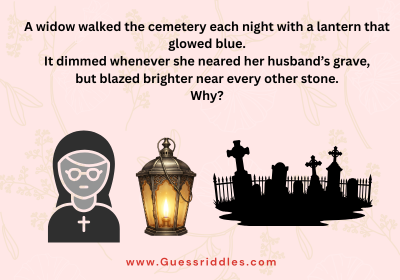
A widow walked the cemetery each night with a lantern that glowed blue.
It dimmed whenever she neared her husband’s grave,
but blazed brighter near every other stone.
Why?
Answer:
||The lantern was fueled by a draft coming from a hidden crypt—its airflow weakened near her husband’s solid tomb||
Explanation:
The Riddle
A widow walked the cemetery each night with a lantern that glowed blue.
It dimmed whenever she neared her husband’s grave,
but blazed brighter near every other stone.
Why?
Step 1: The Emotional Misdirection
The setup strongly encourages a symbolic interpretation:
- Widow → grief, devotion, ritual
- Cemetery at night → spirits, liminality
- Blue glow → ghostly fire, souls, will-o’-the-wisps
- Lantern dims at husband’s grave → recognition, mourning, reunion
It feels as though the lantern knows where her husband lies.
That assumption is the trap.
Step 2: Focusing on the Lantern, Not the Widow
The riddle never claims:
- The widow controls the lantern
- The lantern responds to emotion
- Anything supernatural is present
It only describes changes in brightness based on location.
So the key question becomes:
What physical condition changes from grave to grave?
Step 3: The Real Cause Revealed
The answer explains:
The lantern was fueled by a draft coming from a hidden crypt—its airflow weakened near her husband’s solid tomb.
Here’s how that works.
Step 4: How Airflow Controls the Flame
1. The Blue Flame
A blue flame suggests:
- A clean-burning fuel
- Low soot
- Sensitive dependence on oxygen flow
Such flames grow brighter with increased airflow and dim when air is restricted.
2. The Hidden Crypt
Some graves are not solid:
- Old crypts may vent air through cracks
- Underground chambers can “breathe” as temperatures shift
- Rising warm air creates subtle drafts at the surface
When the widow walks near these graves:
- Extra airflow feeds the lantern
- The flame brightens noticeably
3. Her Husband’s Tomb
Her husband’s grave, by contrast:
- Is fully sealed
- Has no hollow space beneath
- Produces no rising air
When she nears it:
- The lantern loses its extra draft
- The flame weakens and dims
The change feels meaningful—but it’s mechanical.
Step 5: Why It Seems Intentional
Humans are extremely prone to pattern–emotion coupling.
When:
- A change coincides with grief
- The setting is symbolic
- The effect repeats consistently
The mind concludes:
This must mean something.
In truth, the lantern is responding only to air.
Step 6: Why the Riddle Is So Effective
- Blue light is culturally linked to spirits
- Cemeteries heighten emotional interpretation
- The exception (her husband’s grave) reinforces the illusion
- Physics quietly imitates intention
The widow’s ritual gives the phenomenon meaning—but does not cause it.
Final Answer Explained
Why did the lantern dim near her husband’s grave?
Because the lantern’s blue flame was strengthened by drafts rising from hollow graves and hidden crypts—and her husband’s solid tomb provided no airflow to feed it.
Riddles by Category:


Previous Post:Tricky Logic Riddles to Challenge Your Mind