
Here’s a riddle from The Temple of Moving Walls.
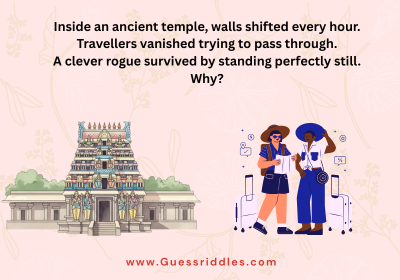
The Temple of Moving Walls
Inside an ancient temple, walls shifted every hour.
Travellers vanished trying to pass through.
A clever rogue survived by standing perfectly still.
Why?
Answer:
||The walls only moved when detecting motion||
Explanation:
The Riddle
Inside an ancient temple, walls shifted every hour.
Travellers vanished trying to pass through.
A clever rogue survived by standing perfectly still.
Why?
Step 1: Establishing the Danger
The riddle sets up a threatening environment:
- Walls shift every hour → seemingly autonomous, dangerous movement
- Travellers vanish → implies deadly consequences, perhaps magical
- Ancient temple → emphasizes mystery and antiquity
Readers naturally assume the walls move regardless of behavior, punishing anyone in their path.
Step 2: Key Observation
The rogue survives without fighting or avoiding the walls—just by standing still.
This is the first clue that the “trap” responds to something other than time alone.
Step 3: The Real Mechanism Revealed
The solution:
The walls only moved when detecting motion.
Here’s how it works:
1. Motion-Sensitive Mechanism
Ancient temples (or riddles) often feature mechanical traps:
- Pressure plates, levers, or optical triggers
- Hidden mechanisms that respond to weight or movement
- Walls designed to crush intruders unless they are stationary
The “hourly” movement is misleading: it only occurs when a trigger is activated, not on a fixed schedule.
2. Standing Still Bypasses Detection
By remaining perfectly still:
- The rogue avoids triggering the motion sensors
- The walls shift harmlessly without contacting him
- He can move only when the mechanism allows it
This is a clever inversion of expectation: survival is passive, not active.
3. Why Others Fail
Travelers assume:
- Moving forward is necessary
- Their timing matters more than their behavior
But every motion they make triggers the walls, making the temple seem deadly.
Step 4: Why the Riddle Works
- It exploits assumptions about progress
- It punishes habitual action and rewards observation
- It transforms a mechanical system into a “magical” obstacle
The temple seems intelligent, but it is only reactive, not sentient.
Final Answer Explained
Why did the rogue survive?
Because the walls’ movement was triggered by detecting motion. By standing perfectly still, he avoided activating the mechanism and remained unharmed.
Riddles by Category:


Previous Post:Tricky Logic Riddles to Challenge Your Mind