
Here’s a riddle from The Door That Wouldn’t Cast a Shadow
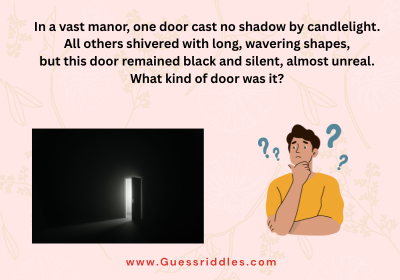
The Door That Wouldn’t Cast a Shadow
In a vast manor, one door cast no shadow by candlelight.
All others shivered with long, wavering shapes,
but this door remained black and silent, almost unreal.
What kind of door was it?
Answer:
||A deep alcove disguised as a doorframe||
Explanation:
The Riddle
In a vast manor, one door cast no shadow by candlelight.
All others shivered with long, wavering shapes,
but this door remained black and silent, almost unreal.
What kind of door was it?
Step 1: Why the Lack of a Shadow Feels Wrong
Candlelight is:
- Low
- Directional
- Unsteady
That kind of light exaggerates shadows. So when every other door casts a shadow, the expectation is absolute:
Anything solid should interrupt the light.
The absence of a shadow suggests something unnatural:
- A phantom door
- An illusion
- A doorway to nowhere
The riddle leans into that discomfort.
Step 2: Questioning the Assumption
The key assumption is hidden in the wording:
“One door cast no shadow.”
But the riddle never proves it is truly a door—only that it looks like one.
So the right question becomes:
What looks like a door, but doesn’t behave like a solid object?
Step 3: The Real Explanation Revealed
The answer gives it away:
A deep alcove disguised as a doorframe.
Here’s why that produces the effect.
Step 4: How an Alcove Erases Shadows
1. Shadows Require a Surface
A shadow appears when:
- Light hits a surface
- An object blocks part of that light
- The blocked light is projected onto another surface
A deep alcove breaks this process.
2. Light Is Swallowed, Not Blocked
Instead of a flat door:
- The alcove recedes deeply into the wall
- Candlelight enters but doesn’t strike a back surface
- The interior remains dark, absorbing light rather than redirecting it
With no reflected light, there is:
- No contrast edge
- No defined outline
- No shadow cast outward
The darkness belongs to the space itself.
3. Why It Looks “Black and Unreal”
Human vision expects:
- Depth cues
- Reflections
- Edges
A deep, unlit recess offers none of these. The result feels:
- Flat but infinite
- Present but intangible
The brain struggles to interpret it as a normal object.
Step 5: Why All Other Doors Cast Shadows
Real doors:
- Protrude slightly
- Have frames, panels, or handles
- Interrupt candlelight at clear angles
Even small details create long, trembling shadows in candlelight.
The alcove does none of this—it accepts the light instead of deflecting it.
Step 6: Why the Riddle Feels Eerie
Darkness without shadow feels wrong because:
- Shadows explain darkness
- Darkness without shadow suggests depth without boundary
That contradiction makes the “door” feel unreal—like a void cut into the manor.
Final Answer Explained
What kind of door was it?
Not a door at all, but a deep alcove shaped like a doorframe, absorbing candlelight so completely that it cast no shadow.
Riddles by Category:


Previous Post:Tricky Logic Riddles to Challenge Your Mind