
Here’s a riddle from The Raven’s Secret
The Raven’s Secret
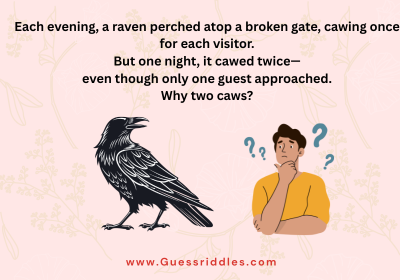
Each evening, a raven perched atop a broken gate, cawing once for each visitor.
But one night, it cawed twice—
even though only one guest approached.
Why two caws?
Answer:
It echoed against the metal bars, creating a second call.
Explanation:
The Riddle
Each evening, a raven perched atop a broken gate, cawing once for each visitor.
But one night, it cawed twice—
even though only one guest approached.
Why two caws?
Step 1: Establishing a Pattern
The riddle first teaches us a “rule”:
- One visitor → one caw
- The raven appears deliberate and reliable
This makes the raven seem almost sentient or prophetic, as though it is counting souls or announcing arrivals.
So when the pattern breaks, the reader assumes:
Something unusual must have happened.
Possibilities the riddle invites:
- A hidden second visitor
- A spirit unseen
- The raven foretelling something yet to come
This is intentional misdirection.
Step 2: Questioning the Assumption
The key is to question what actually counts as a “caw”.
The riddle says:
- The raven cawed once
- Yet two sounds were heard
It does not say:
- The raven opened its beak twice
- The raven intended to caw twice
The discrepancy may lie in how the sound traveled, not in what the bird did.
Step 3: The Physical Environment Matters
The answer reveals the real cause:
It echoed against the metal bars, creating a second call.
Here’s how that works:
1. Metal Bars as Sound Reflectors
A broken gate made of iron or steel:
- Reflects sound very efficiently
- Produces sharp, clear echoes
- Can create delayed reflections that sound like distinct repetitions
Unlike stone echoes, metal echoes can be:
- Crisp
- Sudden
- Almost identical to the original sound
2. Timing That Tricks the Ear
If the echo returns quickly—but not instantly—
the human brain interprets it as:
A second, separate caw.
Especially in quiet evening air, even a fraction-of-a-second delay can sound intentional.
3. Directional Confusion
The echo may bounce:
- From behind the listener
- From a different angle than the raven
This spatial separation reinforces the illusion that two calls were made.
Step 4: Why It Only Happened That Night
Several subtle factors can make the echo noticeable only once:
- Cooler evening air carries sound farther
- A change in humidity sharpens reflections
- The visitor’s approach angle altered how sound bounced
- The gate’s broken bars acted like a resonator
So the raven didn’t change—the conditions did.
Step 5: Why the Riddle Feels Supernatural
Humans instinctively associate:
- Ravens → omens
- Counting sounds → judgment or fate
- Broken gates → thresholds between worlds
The riddle leverages those symbols so that a simple echo feels like a sign rather than a coincidence.
Final Answer Explained
Why were there two caws?
The raven cawed once, but the sound echoed off the metal bars of the broken gate, producing a second, identical call.
Riddles by Category:


Previous Post:Tricky Logic Riddles to Challenge Your Mind